



While markets remain glued to the Iran war and the impact that oil prices will have across the financial and economic spectrum, Washington rewrote its copper tariff code. The move will have far-reaching impacts as we detail below.
On April 2, President Trump signed a proclamation restructuring Section 232 copper tariffs, the national-security tariff framework originally put in place in July 2025. The White House noted that the move was put in place “to protect the national security of the United States, including the economic resilience of vital industries and the financial position of American workers.”
The deeper story was that the original copper tariffs were being circumvented by importers undervaluing the copper inside their products, so the White House tightened the rules. Loopholes or not, the new positioning was a clear move to bolster U.S. domestic positioning with steel, aluminum and most importantly copper.
That’s because semi-finished copper products like pipe, wire, and tubing pay a 50% tariff at the U.S. border, and they have since last August. Refined copper itself was exempted from that round, but starting January 2027, refined copper imports will be hit with a new 15% tariff, rising to 30% in January 2028. According to official documents, starting in 2027, importers also have to sell at least a quarter of their copper domestically.
Commerce Secretary Howard Lutnick has been directed to report back to the President by June 30, 2026 on whether to pull the 2027 and 2028 tariff hikes forward. Based on our analysis he will continue this shift, because every policy move out of this administration on critical metals has gone one direction.
Copper is trading around $6.00 per pound on COMEX and just above $13,000 per tonne on the LME, which is near record territory – despite media concerns about swirling over crude oil and geopolitical tensions.
In the 2026 Prinsights forecast, we flagged copper in our top five favorite commodities as a structural long-term investment due to supply concerns and driven more by policy and jurisdiction than cyclical demand. The April 2 proclamation amplified that view.
Meanwhile, there are reports of a copper surplus. On paper, the reported 616,000 tonne copper surplus should not have sent copper price to near record highs. However, that reported surplus doesn’t capture the new tariff floor, the concentrate crisis or the acid shock that can impact copper production.
What the Price Is Telling Us
Copper prices have remained in a powerful uptrend despite war and recession fears. After the March pullback on the heels of the Iran War shock, prices recovered quickly to near record territory.
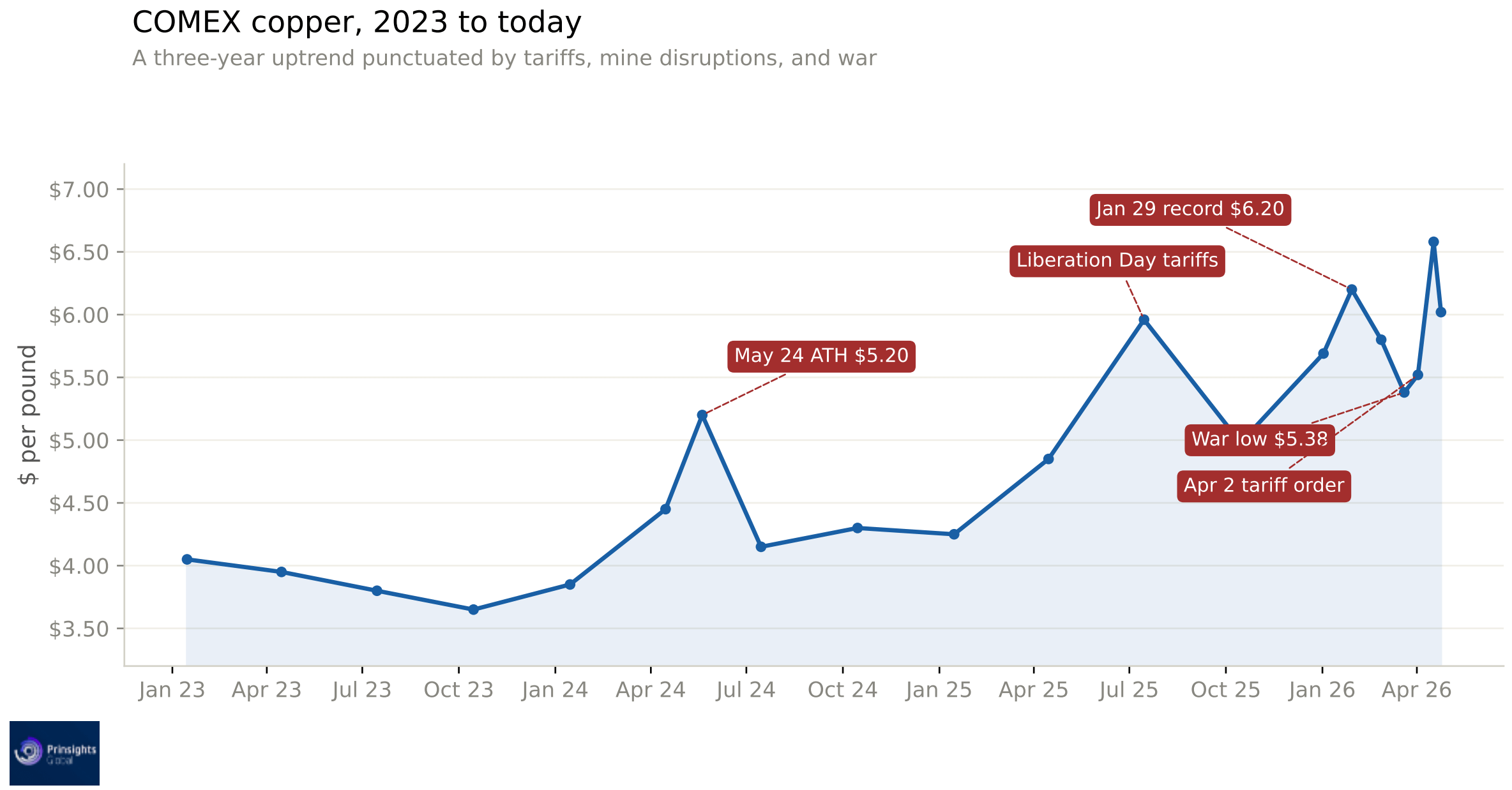
What this means is that the market continues to signal tighter conditions than recent official surplus forecasts suggest. Our Prinsights Pulse Premium analysis shows that this discrepancy is being overlooked and undervalued.
